Nutrition · Research and reflections
A slippery subject: Can eating fat help you lose weight?
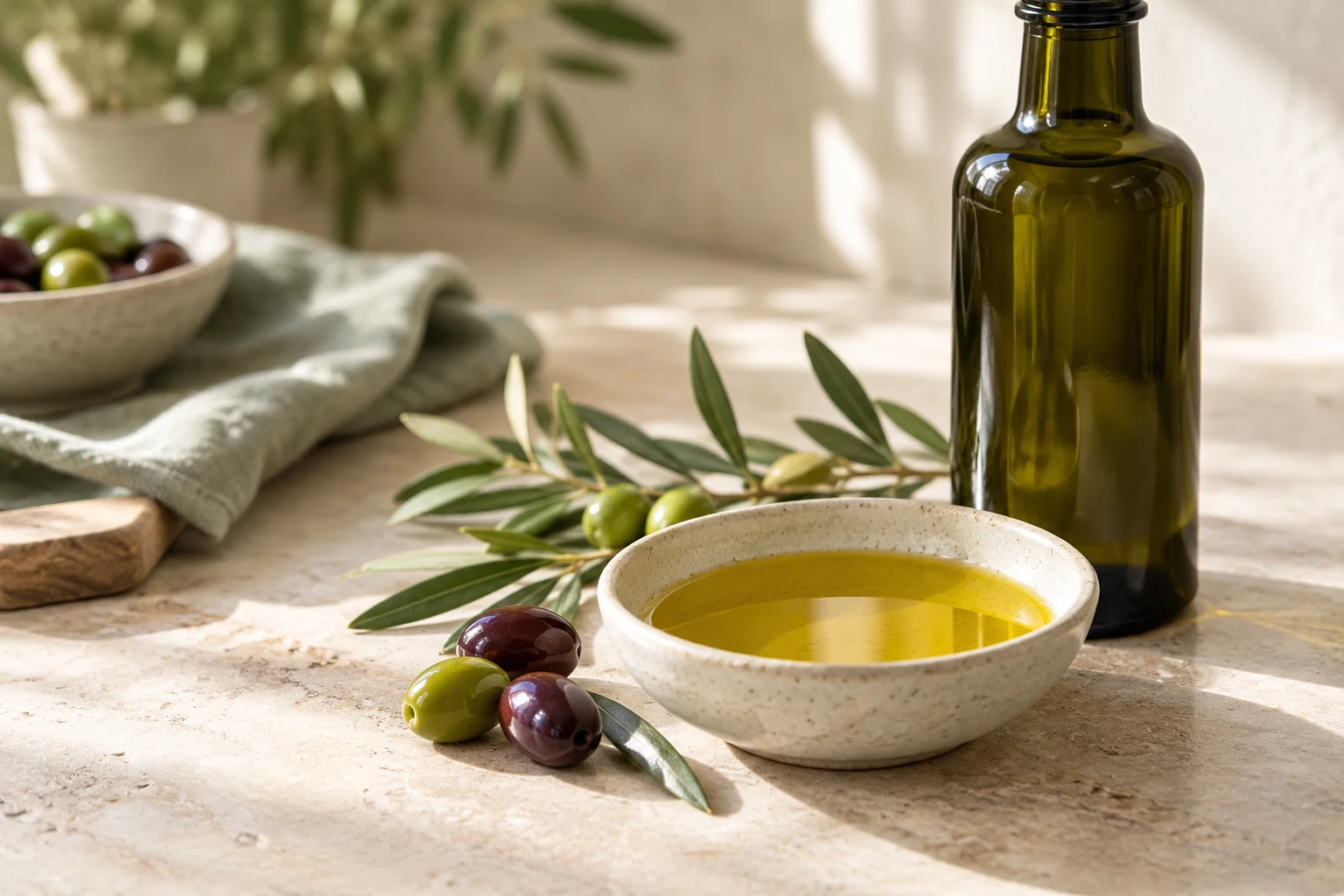
Olive oil, MCT oil and what the science really tells us about healthy fats.
It sounds counterintuitive. We're often told that weight loss requires reducing calories, and fat is the most energy-dense nutrient in our diet. Gram for gram, fat provides more than twice the energy of protein or carbohydrate.
So how is it that some dietary fats have been associated with weight loss?
The answer is a little more interesting than simply counting calories.
Not all fats behave the same way
Dietary fats differ in their chemical structure, how they are digested and how the body uses them.
Two interesting examples are extra virgin olive oil (EVOO), a cornerstone of the Mediterranean diet, and medium-chain triglyceride (MCT) oil, usually derived from coconut or palm kernel oil.
Both provide energy, but they have quite different properties.
Extra virgin olive oil: more than a healthy fat
EVOO is rich in monounsaturated fatty acids, particularly oleic acid. It also contains naturally occurring polyphenols, vitamin E and other compounds with antioxidant properties.
These compounds are one reason EVOO has attracted considerable scientific interest, particularly in relation to cardiovascular and metabolic health.
But what about cooking? Doesn't heating olive oil destroy its beneficial properties?
Some antioxidants are lost during heating, but EVOO is surprisingly stable at normal cooking temperatures.
A 2022 scientific review found that its fatty acid composition and natural antioxidants help protect against oxidation during cooking. Interestingly, some beneficial compounds can also move between the oil and the food being cooked.
So there's no need to reserve your good olive oil exclusively for salad dressings.
Practical tip: Use EVOO for everyday cooking, including sautéing and roasting. Avoid overheating it until it smokes or repeatedly reheating the same oil.
MCT oil: the surprising weight-loss connection
MCT oil is a little different.
Most dietary fats contain long-chain fatty acids. MCTs contain shorter fatty acid chains, allowing them to be absorbed and metabolised differently.
They are transported relatively rapidly to the liver, where they can be used for energy or converted into ketones.
This has prompted researchers to investigate whether replacing some conventional dietary fats with MCTs might influence energy expenditure, fat oxidation and body weight.
And the results are interesting.
A 2015 meta-analysis of 13 randomised controlled trials involving 749 participants found that people consuming MCTs lost, on average, approximately 0.5 kg more weight than those consuming long-chain fats.
A more recent 2024 meta-analysis also reported a modest advantage for MCT-enriched diets, particularly those containing purified MCTs.
This isn't a dramatic effect, but it is intriguing. After all, we're talking about replacing one dietary fat with another, rather than necessarily reducing the amount of fat consumed.
Does that mean adding MCT oil helps you lose weight?
Not necessarily.
The research generally compares MCTs with other dietary fats. It doesn't show that simply adding MCT oil to your usual diet will produce weight loss.
MCT oil still contributes calories.
The potential advantage appears to be related to how these fats are metabolised, rather than an ability to bypass energy balance.
There are also limitations to the evidence, including relatively small trials, differences in study designs and uncertainty about longer-term benefits.
So which oil should you choose?
It depends on what you're trying to achieve.
EVOO has a much broader evidence base supporting its role in a healthy dietary pattern. It also contributes flavour, antioxidants and beneficial unsaturated fats.
MCT oil is an interesting alternative with some evidence of modest metabolic and weight-management benefits. However, it isn't a substitute for an overall nutritious diet.
And coconut oil isn't the same as purified MCT oil. Coconut oil contains a mixture of fatty acids, including substantial amounts of lauric acid, and the findings from MCT studies shouldn't automatically be applied to it.
The takeaway
The most interesting lesson isn't that one oil is better than another.
It's that foods are more than their calorie content. Their chemical composition, how we prepare them and how our bodies metabolise them can all influence their effects.
For most people, EVOO remains an excellent everyday choice. MCT oil may have a place in some dietary approaches, but its benefits are modest and need to be considered alongside the overall diet.
Good nutrition isn't about finding a miracle ingredient. It's about understanding what the evidence tells us and making informed choices that suit our individual needs.
Dr Susan Arentz PhD is a research naturopath specialising in women's reproductive and metabolic health.
Sage by Susan | www.susanarentz.com.au
References
Lozano-Castellón J, et al. Cooking with extra-virgin olive oil: A mixture of food components to prevent oxidation and degradation. Trends in Food Science & Technology. 2022;123:28–36. https://doi.org/10.1016/j.tifs.2022.02.022
Mumme K, Stonehouse W. Effects of medium-chain triglycerides on weight loss and body composition: a meta-analysis of randomized controlled trials. Journal of the Academy of Nutrition and Dietetics. 2015;115(2):249–263. https://doi.org/10.1016/j.jand.2014.10.022
The impact of medium-chain triglycerides on weight loss and metabolic health in individuals with overweight or obesity: a systematic review and meta-analysis. Clinical Nutrition. 2024. https://doi.org/10.1016/j.clnu.2024.06.016